
What results are provided for each of the EYE-TA domains and how are they calculated?
The EYE-TA Class Report provides domain level results for each child in the class. These results are depicted in two ways by:
- number (score ranges from 0-3); and
- colour (green, yellow or red)
The number represents the child’s overall average score for that particular domain (the average of all item scores for that domain). This domain average score ranges from 0-3 and is key in determining whether the associated coloured result will be red, yellow or green. Using the score range (found at the bottom of page 2 of the Class Report), one can determine that if this average score is between 2 and 3 the result will be green, if it is greater than 1, but less than 2 it will be yellow and finally if the average score is greater than or equal to 0 but less than 1 the result will be red. These coloured domain level results correspond with the Child Report.
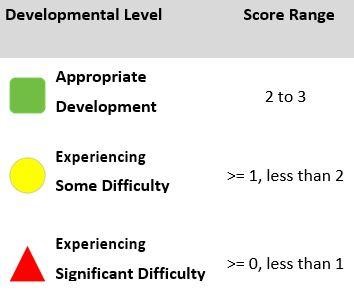
When reviewing children’s domain level results, teachers can easily notice differences between colours. However, also of value is the numeric value within a coloured result. For example, does a child have a ‘high yellow’ score such as 1.8 (almost 2.0 which would produce a ‘green’ result)? Or, is the child’s score more reflective of a ‘low yellow’ such as 1.2. Children with ‘high yellow’ scores will, with maturation and good teaching, likely naturally progress to a green result over time. However, those children with a ‘low yellow’, who are on the cusp of receiving a ‘red’ result, may need further support and experiences with that particular domain skill. Therefore, the EYE-TA domain level results not only provide teachers with which students are in need of support, but also how much support/intervention is needed.

It is important to note that the EYE-TA individual domain (e.g., Cognitive Skills, Language and Communication) results are not normed by age. Because each child’s specific domain result is not normed by age, the child’s average score is likely to improve over the course of a school year, as children mature and benefit from quality learning opportunities at home and at school. Keep in mind that this is a skills based assessment, intended to measure the skills children will need when starting grade one. All children – regardless if they are older or younger kindergarten children, will need the same skills when starting grade one.
What is the Responsive Tiered Instruction Model?
Based on our longitudinal data, Dr. Willms, author of the EYE tools, developed a formula that estimates the probability that a child would likely become a successful reader, in a typical Canadian school, by the end of grade two. Our EYE team uses the term ‘Responsive Tiered Instruction’ as our approach uses the EYE-TA data as a leading indicator of children’s skills as they begin kindergarten and move on towards grade three. The RTI can be used to identify vulnerable children at the beginning of the school year- children who are at risk for later literacy difficulties. It calls for a tiered approach comprised of continuous assessment of children’s progress in the regular classroom setting and providing supports to children who have learning difficulties or behavioural challenges. Many jurisdictions use this kind of model to assist with early identification, intervention and resource allocation.
How is the RTI calculated?
We use a logistic regression model to calculate a score and depending on this score, children are assigned a result of Tier 1, 2 or 3. While the statistics behind this formula are convoluted, a good way to capture the meaning is to think of the formula like a recipe. The first thing to go into the calculation is the age of the child. This is a key difference between RTI scores and domain level scores- age does impact the result of the RTI score, while it has no impact on the domain score. Next, we add in the average scores the child received for each domain. However, much like a recipe we do not add in equal amounts of each score. The domains are weighted depending on how predictive they are of later literacy success. Keeping this in mind, we add ‘1 cup’ of Cognitive Skills (1.0), followed by 0.75 of Language and Communication, 0.25 of Fine Motor, 0.20 Awareness of Self and Environment, and just a dash (0.15) of Social Skills and Approaches to Learning. You will notice that Gross Motor is not included in this formula. While the Gross Motor skills are very important, academic research suggests that they are not predictive of later literacy success.
With this formula, we are able to use the RTI to discern which children are most likely to require extra support during the primary school years – our most vulnerable learners. The RTI approach is an inclusive approach to meeting children’s learning needs; it requires that all children receive Tier 1 instruction in the regular classroom. Tier 1 entails quality instruction using universal strategies and approaches in play-based learning environments and would apply to children who have Tier 1 learning needs. Children with Tier 2 learning needs will also receive targeted, small group instruction that can be provided within or outside the classroom. Children with Tier 3 learning needs may require more intensive additional instruction and a carefully planned program tailored to their specific learning needs.

Is it possible for a child to receive domain results that are green across all domains and still end up with a RTI result of Tier 2 (yellow)?
There are three things to consider when interpreting these particular results:
- The age of the child
- The domain
- The domain score(s)
As mentioned previously, the age of the child is factored into the RTI result. Consequently, a child who is older for the cohort, receives a ‘low green’ domain result in a domain that is heavily weighted in the formula (i.e., Cognitive or Language and Communication) and this could lead to him or her being placed in RTI Tier 2. However, this is a rare occurrence that will likely occur in less than 2% of the cases. We could have set the criteria less stringently, but our argument is that we do not want any ‘false negatives.’ A false negative is when we say the child has Tier 1 learning needs, but then the child fails to become a successful reader. These are the children we say, ‘fell through the cracks’.
Is it possible for a child to receive domain results that are red and yellow and still end up with a RTI result of Tier 1 (green)?
There are occasionally cases where children have domain result(s) that are yellow and may even have a red domain result(s) but is indicated as having RTI Tier 1 results. One must once again take into account the child’s age, domains they scored red and yellow in, and the domain results for heavily weighted domains. Therefore, a child who is younger, receives yellow or red results in a domain(s) that are not heavily weighted (i.e., Socials Skills and Approaches to Learning or Gross motor), and whose results in heavily weighted domains (i.e., Cognitive or Language and Communication) are green, may end up being indicated as having Tier 1 learning needs.