
What do the Pre-Post (fall/spring) EYE-TA results provide educators?
Pre-Post EYE-TA results provide educators with information about the effectiveness of supports that are in place and how children are responding to the supports that have been implemented throughout the school year. Educators use this information to help guide the next steps in supporting children in kindergarten as they transition to grade one. Pre-Post EYE-TA results indicate children’s progress and how effective and appropriate the supports have been in meeting the needs of the children in the program.*
What does it mean if a child’s domain score only increased slightly and/or did not change colour?
While we know that children will tend to demonstrate progress over the course of the school year, progressing from one colour to the next (e.g., red to yellow, or yellow to green) is sometimes subtle and growth is seen within the colour instead (e.g., the score increases from .20 to .98 but remains red). Each child is unique and has distinct benchmarks of success. For some children, these results may indicate that the supports may not be effective or additional supports are required for the child. While for other children, these results may indicate and account for the supports being effective, appropriate and responsive. Remember, a single assessment does not provide a comprehensive view of children’s learning and development. Educators are encouraged to consider the results in the context of on-going evaluation and responsiveness to assessment and instruction.
The Responsive Tiered Instruction (RTI) result for a child in my class has changed from a Tier 3 (red) in the Pre EYE-TA session (fall) to a Tier 1 (green) in the Post EYE-TA session (spring). Does this mean that the child no longer needs additional support?
Not necessarily. The Post EYE-TA results assist educators in determining the effectiveness of the supports and how children are responding to the supports. While there are a number of factors to consider, these results suggest that the child is responding well to the supports that the multidisciplinary team has implemented.* However, this child may require continued monitoring. It is important to continue with supports that are effective and responsive to the child’s strengths and needs. For example, if the child is responding well to small group instruction, continued use of small group instruction would be beneficial and considered an effective support. A change in a child’s RTI results from a Tier 3 (red) to a Tier 1 (green) does not necessarily mean the child no longer requires support; rather, it means that the supports are effective and responsive, enabling the child to meet the developmental benchmark requirements assigned to the domain.
How can educators use the Pre-Post EYE-TA results to support successful transitions to grade one?
The Pre-Post EYE-TA results provide educators and multidisciplinary teams with information about children’s strengths and areas of need in kindergarten. As children transition from kindergarten, the information can be shared with grade one educators to establish effective supports and develop a transition plan ensuring that resources are in place to support the children the moment they enter grade one. For example, if the child is responding well to the use of visual prompts and cues, continue using this strategy in grade one. While some children may show results that indicate steady progress, others may not be progressing as quickly as expected. This is valuable information for the grade one educator as there may be other factors to consider that may be impacting a child’s progress, which invites the multidisciplinary team to re-evaluate the recommended supports and responses.
To support multidisciplinary teams in planning for successful transitions, teams may consider reflecting on the following questions:
- What supports were implemented in kindergarten?
- What worked well and responded to the child’s needs?
- What supports and responses did not work well and why?
- How can this information support children in transitioning to grade one?
- How can this information support educators in developing a plan for children as they enter grade one?
- What supports are required and need to be in place for successful transitions to grade one?
Educators can refer to the Pre-Post EYE-TA results to evaluate the effectiveness of supports and how children are progressing. For example, the results for:
- Child 1 in the report below suggests that the supports in place are effective and responsive to the child’s strengths and needs.
- Child 9 in the report below suggests that some supports are effective however, the supports will need to be reviewed for additional appropriate responses.
- Child 4 in the report below suggests that the team will need to review and evaluate the supports in place to create a new plan that is appropriate and responsive to the needs of the child.
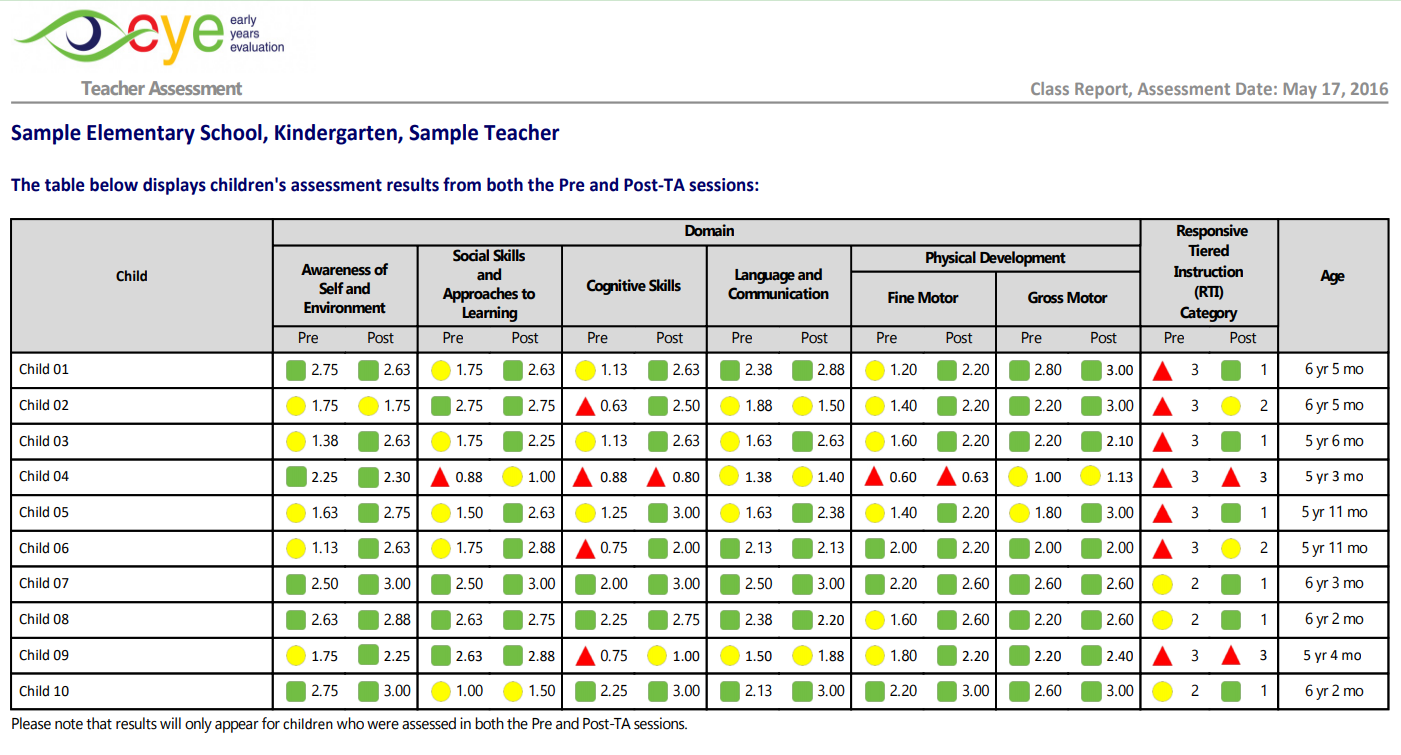
* While there are other factors, beyond the strategies used, that could account for a change in a child’s Pre-Post EYE-TA results (e.g., maturation, home experience/environment, health, learning styles etc.) educators should use their professional judgment to assess the impact of structured supports. Consider results in the context of ongoing teacher evaluation and the child’s responsiveness to tiered instruction.